RV Battery Replacement - Daytona Beach, FL
RV Repair Daytona Beach tests your house and chassis battery banks with a digital load tester and conductance meter before recommending replacement, so you never pay for batteries that don't need changing. We install AGM, gel, and lithium iron phosphate (LiFePO4) batteries on-site and properly dispose of the old units. Most single-bank replacements are completed in under 90 minutes including post-install charging verification.
How RV Repair Daytona Beach Tests RV Batteries - Why Resting Voltage Alone Is Meaningless
A 12V AGM battery that shows 12.6 volts at rest appears fully charged on a simple multimeter. However, a battery with severe internal sulfation or a failed cell can read 12.6 volts at rest and collapse to 10 volts within seconds of a moderate load - a condition that causes inverter shutdowns, slow slides, and dim lighting that no resting voltage reading would predict. RV Repair Daytona Beach tests every battery with a Midtronics conductance meter that measures internal resistance and compares it to the battery's original impedance specification, then applies a calibrated load that simulates real operating conditions.
A battery testing below 60 percent of its original rated capacity is past its useful service life regardless of resting voltage or how recently it was charged. This test is performed on each battery individually - a six-battery bank with one failed cell will test poorly as a unit, but conductance testing identifies which specific battery is pulling down the bank.
AGM, Gel, or Lithium LiFePO4 - Selecting the Right Battery Chemistry for Your RV
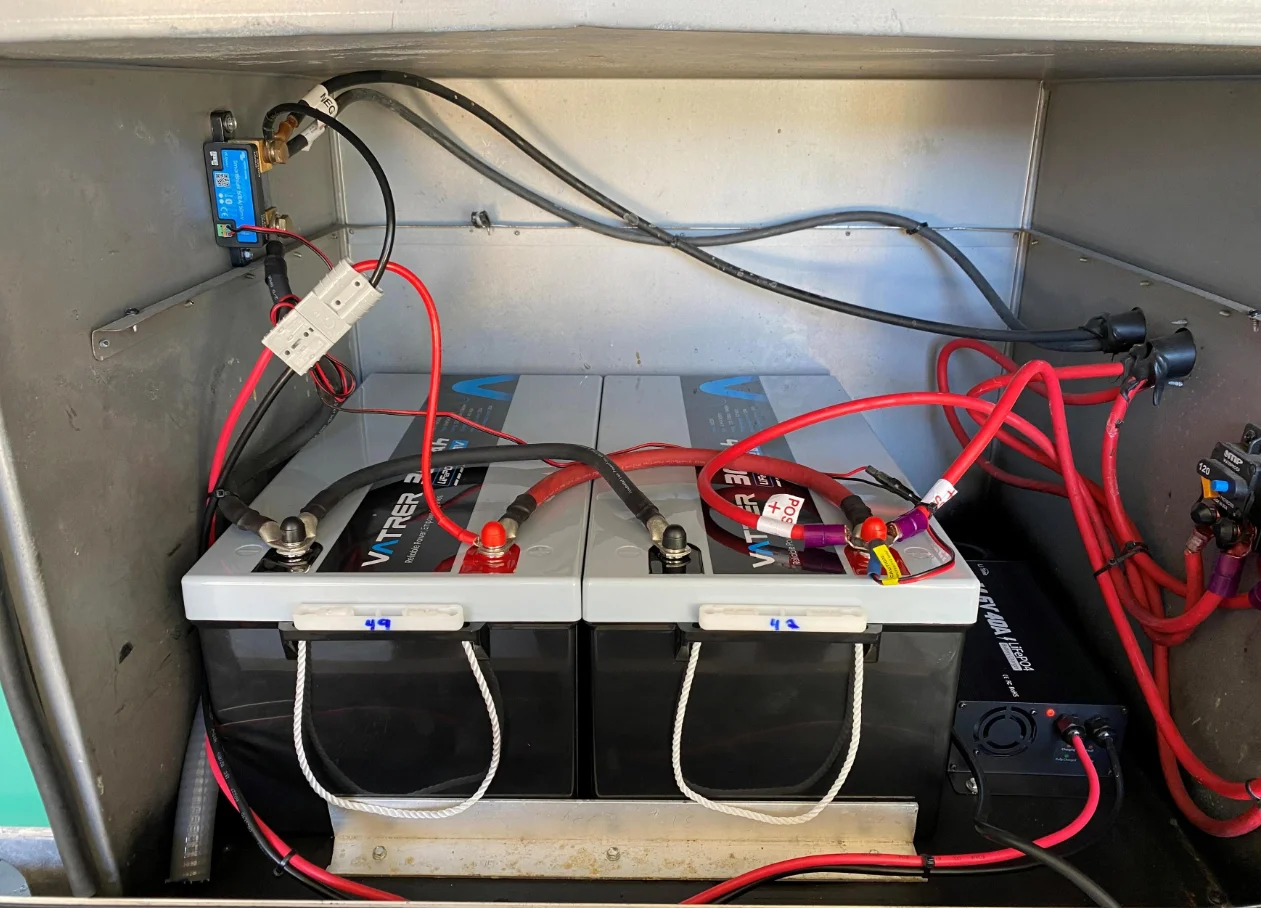
AGM (absorbed glass mat) batteries are the standard replacement for most conventional RV house banks - they are spill-proof, charge well with standard converters and solar charge controllers, and have a proven track record in the RV environment. Gel batteries require a lower absorption voltage than AGM and are frequently damaged by chargers configured for AGM - unless you have a charger specifically designed for gel chemistry, AGM is the safer default. Lithium iron phosphate (LiFePO4) batteries offer approximately twice the usable capacity at half the weight compared to equivalent AGM, charge three to four times faster, and have a cycle life of 2,000 to 4,000 full cycles versus 400 to 600 for AGM.
The critical requirement for lithium is verifying all charging sources - the converter, solar charge controller, and alternator charging circuit - are lithium-compatible. Most WFCO and Parallax converters are not lithium-compatible; a Progressive Dynamics PD9200 can be configured for lithium charging. We verify all charging sources before installing any lithium bank.
RV Electrical System Repair Cost in Daytona Beach, FL
| Service | Typical Cost | Notes |
|---|---|---|
| Service Call + First Hour | $299 - $399 | Travel + diagnostics anywhere in Volusia County |
| Battery Replacement | $150 - $400 | Per battery; group 27 / 31 deep cycle |
| Converter / Charger Repair | $200 - $600 | Diagnose and repair or replace |
| Inverter Repair or Replacement | $300 - $800 | Modified or pure sine wave units |
| Shore Power Outlet Repair | $100 - $250 | 30A or 50A pedestal connection |
| Breaker Panel Repair | $200 - $500 | Includes diagnosis and breaker swap |
| Wiring Diagnosis | $150 - $350 | Fault isolation; one-hour minimum labor |
Pricing note: Ranges shown are average costs for the Daytona Beach, FL market based on common repair scenarios. The exact cost of your repair depends on your RV make and model, the severity of the issue, and parts availability.
Only a technician on-site can provide an accurate estimate after inspecting your RV. A written estimate is provided before any work begins - you approve it before we start.
RV Battery Replacement - Common Questions
How do you determine if my batteries need to be replaced or just recharged and equalized?
We test each battery individually using a conductance meter, which measures internal resistance and compares it to the battery's rated capacity - this gives a reliable read even on a partially discharged pack. A battery that tests below 60% of rated capacity under load is past its service life regardless of resting voltage. If the bank tests recoverable, we equalize and do a full charge cycle before declaring it good.
Is it worth upgrading to lithium LiFePO4 batteries in my RV?
Lithium makes the most sense if you boondock regularly, run high-draw appliances like an Instant Pot or residential refrigerator, or your current AGM bank is already due for replacement. LiFePO4 delivers roughly twice the usable capacity at half the weight compared to AGM and charges three to four times faster. The upfront cost is higher, but for heavy users the cycle-life math typically pays back within two to three years.
My slide-out is slow and my 12V lights are dim even when plugged in - is that a battery problem?
Slow slides and dim 12V lighting under shore power usually means the converter is not charging the battery bank properly, leaving it chronically undercharged. However, a severely sulfated AGM bank can draw so much current from the converter that output voltage drops below the threshold slides and lights need to operate correctly. We test both the converter output and battery bank health together to find which component is responsible.
How long do RV AGM batteries typically last and what shortens their life?
A quality RV AGM battery from Battle Born, Lifeline, or Trojan has a rated life of 400 to 600 full discharge cycles under proper charging conditions, which translates to 3 to 7 years depending on use frequency. The three most common causes of premature failure are chronic undercharging from an undersized converter, chronic overcharging from a single-stage converter set too high, and repeated deep discharge below 50 percent state of charge. A multi-stage converter like the Progressive Dynamics PD9200 and a battery monitor that alerts before the bank reaches 50 percent discharge are the two most effective ways to maximize AGM battery life.
Can I mix old and new batteries in my RV house bank?
Mixing batteries of different ages, capacities, or even different brands in a bank always results in the new battery trying to compensate for the weaker older batteries, which shortens the new battery's life significantly. When one battery in a bank fails, the correct approach is testing each remaining battery individually and replacing all batteries that fall below 70 percent of rated capacity in the same service visit. Installing a single new battery alongside four old ones is nearly always a short-term solution that wastes the new battery.