RV Solar Wiring Repair - Daytona Beach, FL
RV Repair Daytona Beach traces and repairs damaged, corroded, or undersized solar wiring from panel to battery at your site. We pull conductor sizing calculations, replace any wire run that cannot carry the array's rated short-circuit current safely, re-terminate MC4 connectors, reseat breakers and fuses, and confirm voltage drop is under three percent end-to-end before closing up. Most wiring repairs are completed same-day.
Common RV Solar Wiring Faults and How They're Found
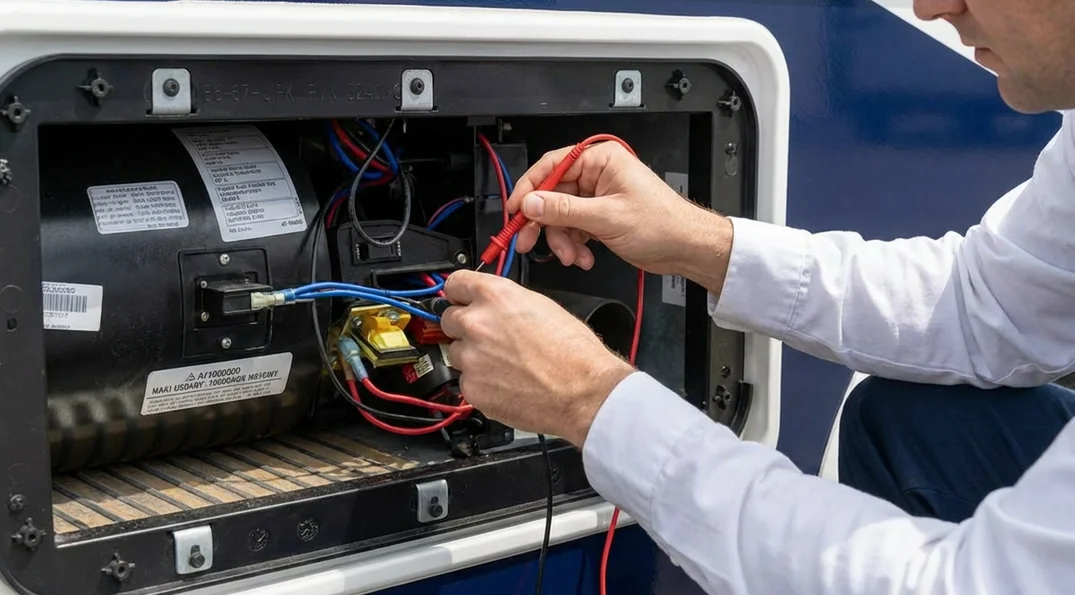
Solar wiring faults fall into three categories: open-circuit faults that stop current flow entirely, high-resistance faults that reduce current flow and generate heat, and insulation faults that create ground paths or shock hazards. Open-circuit faults are found by measuring voltage at progressive points along the wiring path - panel output, MC4 connector pair, roof entry point, controller input - and identifying where voltage disappears. High-resistance faults require a voltage drop measurement under load, because a high-resistance connection may show correct voltage open-circuit while dropping significant voltage when current flows.
We measure voltage drop across each MC4 connector pair during charging - a good connection drops less than 0.1 volts at rated current. A drop above 0.3 volts indicates a high-resistance joint that will worsen over time. Insulation faults require an insulation resistance test with a megohmmeter - we apply a test voltage between the conductor and the chassis and measure the resistance.
A properly insulated conductor reads above 100 megohms.
MC4 Connector Replacement and Crimping Standards
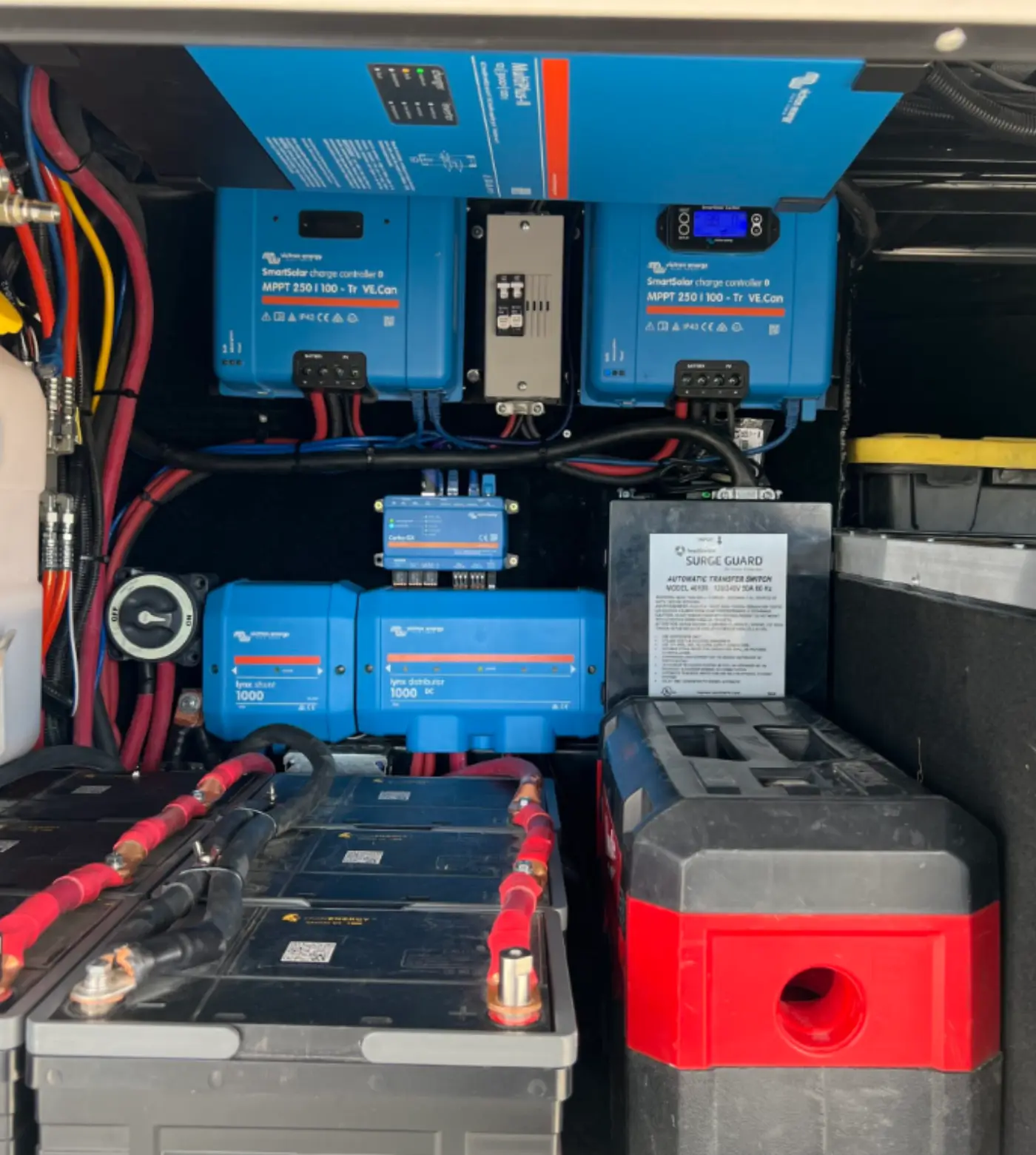
MC4 connectors are the standard solar panel wiring connector used by Renogy, Zamp, Go Power, and virtually all other residential and RV solar panel manufacturers. They are designed for a specific crimping sequence and tool - a correct MC4 crimp requires the correct die set for the wire gauge, the correct pin, and the correct insertion sequence into the housing. Incorrectly crimped MC4 connectors pass initial testing but fail under thermal cycling because the crimp joint expands and contracts at a different rate than the housing, eventually working loose.
We use calibrated ratchet MC4 crimping tools and crimp pins from the same manufacturer as the connector housing to ensure compatibility. After crimping, each connector pair is tested with a pull-force check - a correctly crimped pin requires 40 to 60 pounds of force to extract from the housing. We test polarity before making any connections, because reversed polarity on an MC4 pair damages the charge controller input circuit on first connection.
RV Solar Installation & Repair Cost in Daytona Beach, FL
| Service | Typical Cost | Notes |
|---|---|---|
| Service Call + First Hour | $299 - $399 | Travel + diagnostics anywhere in Volusia County |
| Single 200W Panel Install | $400 - $700 | Panel, wiring, and roof penetration seal |
| 400W Dual Panel System | $750 - $1,300 | 2 x 200W panels, MPPT controller, and wiring |
| 100Ah Lithium Battery Install | $600 - $1,000 | Drop-in lithium; includes BMS and wiring updates |
| MPPT Charge Controller Replace/Install | $200 - $450 | Victron or Renogy MPPT; includes programming |
| Solar Diagnostic and Repair | $150 - $350 | Panel output test, controller check, shading analysis |
Pricing note: Ranges shown are average costs for the Daytona Beach, FL market based on common repair scenarios. The exact cost of your repair depends on your RV make and model, the severity of the issue, and parts availability.
Only a technician on-site can provide an accurate estimate after inspecting your RV. A written estimate is provided before any work begins - you approve it before we start.
RV Solar Wiring Repair - Common Questions
What gauge wire should connect my solar panels to the charge controller?
Wire gauge depends on the array's maximum short-circuit current and the length of the run - longer runs and higher current require heavier gauge to keep voltage drop under three percent. A 400W 12V array running 20 feet from roof to controller typically needs 10 AWG wire at minimum; under-sized wiring creates heat and wastes power. We calculate the correct gauge on-site and carry 10 AWG and 8 AWG marine-grade wire for most residential RV installs.
My MC4 connectors are corroded and I am losing voltage - can they be repaired or do they need to be replaced?
MC4 connectors that show green or white corrosion on the pins cannot be cleaned reliably - the corrosion increases resistance and can cause heat buildup at that joint over time. The correct repair is to cut the old connector off cleanly, strip fresh wire, and crimp a new MC4 connector with the proper MC4 crimping tool rather than pliers. Our techs carry a full MC4 kit and test contact resistance after every new crimp.
Can rodent or UV damage to solar wiring be a fire hazard in an RV?
Yes - solar circuits carry DC current continuously in daylight with no way to switch off the panel side, so any nick or abrasion in the insulation is a live fault. Rodent chews and UV-cracked conduit are the two most common causes of arc faults in roof-to-controller runs. We inspect the entire wire path, sleeve exposed runs in UV-resistant loom, and can install a Midnite Solar or Blue Sea combiner with a class T fuse at the battery for overcurrent protection.
How long should MC4 solar connectors last before needing replacement?
Quality MC4 connectors from Staubli - the original MC4 manufacturer - or from major panel manufacturers are rated for 25 years of outdoor use when correctly installed. Generic or incorrectly crimped connectors fail in two to five years. If your solar system was installed by someone using generic unbranded connectors, have the connections inspected and replaced with quality hardware before a failure causes a more expensive problem.
Is it safe to work on RV solar wiring while panels are in the sun?
No - solar panels produce voltage whenever they are illuminated and cannot be turned off without covering or disconnecting them. Working on an energized solar circuit risks arc flash and equipment damage.
We always cover panels with an opaque tarp before working on any wiring in the solar circuit. If you need to make a repair before a technician arrives, covering panels with a heavy blanket or cardboard reduces their output by 90 percent and makes the circuit safer to handle.